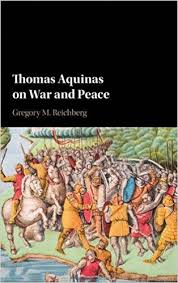
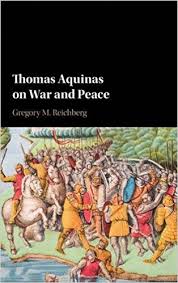
I indicated in my last post that I planned to write more about the Romans, but the news over the last couple of days has prompted me to discuss today a subject that I had planned for a later date. If you read this post, the relevance of this subject will likely become fairly obvious. In much of this discussion, I am indebted to the work of Gregory Reichberg, to presentations by him and some talks we’ve had at the annual McCain Conferences at the U.S. Naval Academy, to some of his shorter writings, and to his recent Thomas Aquinas on War and Peace (Cambridge, 2017).
War has been compared to an art, to a science, to commerce and to sport. These are metaphors, and as such all may have their uses, but a little-known section of Thomas Aquinas’ massive Summa Theologica posits what is possibly the richest and most accurate characterization of command in war, which that it is an act of moral prudence.
In his typical interrogatory style, Aquinas begins by asking, “Whether military prudence should be reckoned a part of prudence?” He notes three objections. First, that warfare is an art, which (citing Aristotle) is distinct from prudence. Second, that although military affairs come under politics, so do other matters, such as trade, which are not of prudence. Third, that soldiers have need of fortitude rather than prudence. Aquinas both poses a general answer to the objections to military prudence, and he also addresses the three objections individually. He acknowledges that war has aspects of art, such as in the use of “external things, such as arms and horses,” but that as it pertains to the public good, it belongs to prudence. His argument against the second objection also invokes the “common good” as an aim in warfare that relates it to prudence. Thirdly, Aquinas says that the direction of war requires prudence as well as fortitude. As noted by Reichberg, the arguments of Aquinas concerning war and prudence have been neglected, eclipsed by other descriptions and metaphors for how soldiers think. To revive this idea for modern readers, a few words of translation are necessary.
Prudence meant more to the ancients and later Latin-speakers than it does to modern English-speakers. Today in common use prudence is almost synonymous with caution. When we pair it with “moral,” it is to emphasize its status as more than mere caution, and as a moral as well as an intellectual virtue. When we speak of military prudence, we are assuming a prudence that has already accepted the unavoidable hazards and mischances of war. It is in fact these very elements of armed conflict that make moral prudence perhaps the sine qua non of the exercise of military leadership and command. Art is concerned with things to be made, prudence with things to be done. Art (and also science, craft, business, or sport) do not require complete virtue in a person, but prudence does. Prudence is a “thick” conception of virtue that calls for character plus skill. Further, the truly prudential commander would not seek victory alone, nor a narrow national interest, but a common good. Aquinas’ identification of military prudence accords with his precepts on just war. Just as skill is not enough for the commander, justice or law is not enough among nations. There must be amity as well. The officer who thinks as an artist or scientist, even if subject to law, but who lacks the virtue of military prudence is more likely than the prudent commander to confuse ends and means, to act in a short-sighted way, to surrender to expediency. Since prudence is both a moral and an intellectual virtue, the principle of the golden mean, of navigating between extremes is given emphasis. Few have greater need for this principle than the military commander, who is constantly performing a balancing act between undesirable courses and outcomes. In military operations, the apparently better course is often the lesser, since it will be too obvious and anticipated by the enemy. The need for progress and victory must be weighed against the cost, and the tendency to escalate, and the need to exert superior force against the potential for excessive, engulfing destruction.
I’ll have much more to say on military prudence in my next book, “How to Think Like an Officer.”
Peace,
Reed


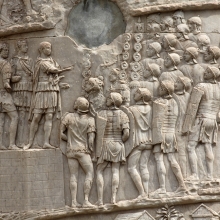 In the Teaching Guide, I ask “What were the Roman approaches to education and to religion? Can we learn from these?” This is another second-order question in that more research could be done on Roman educational and religious practices. It may be a third-order question (a puzzler) in that the influence of education and of religion on a society and on the military is a nearly bottomless subject that no one can claim to have mapped out definitively. A discussion of this question could lead to another on how students view the importance of education and religion (or the lack thereof) in their own lives. Like the question on the experience of Greek battle that I posed a few days ago, this one could serve as a “distant mirror” (to use Barbara Tuchman’s titular phrase) reflecting on our own lives.
 Soldiers and Civilization