The Greeks
April 3, 2017
I posted another quotation from Soldiers and Civilization on the Excerpts page.
Next post: More on George C. Marshall, soldier of civilization.

I'm a retired Marine Corps infantry officer and field historian with a doctorate in literature and a background as teacher and administrator in higher education. I've taught at Boston University, the U.S. Merchant Marine Academy, and for the Marine Corps Command and Staff College (distance education). My wife and I have three sons, all working or on college. She practices medicine at a federally-funded clinic in the Bronx. We live in Larchmont, NY.
I posted another quotation from Soldiers and Civilization on the Excerpts page.
Next post: More on George C. Marshall, soldier of civilization.
I’ll have to write more about my hero George C. Marshall, VMI 1901, Army Chief of Staff 1939-1945, Secretary of State and Defense, and the only American professional soldier to receive the Nobel Prize for Peace, but for now I’ll post the clip below. Orson Welles, who met many of the famous and distinguished people of his day, called Marshall the greatest man he had ever met. A nice anecdote and tribute from a great artist to a great soldier.
As some of you know, I’m currently writing another book with the working title, “How to Think Like an Officer.” In this post, I’ll write about the origins of this project and its current status. Comments welcome, even more than usual!
In my years working at the Merchant Marine Academy, I sometimes thought of my job as getting the midshipmen to think like officers. I’d even say that. “I have a year (or 4 years, or six months, however much time remained until graduation) to get you to think like an officer.” I once, exasperated with a colleague (and good friend) told her that she needed to start thinking like an officer. What did I mean by that? In the case of the midshipmen,I often meant that they needed to think beyond the technical requirements for a maritime officer that occupied most of the Kings Point curriculum, to think of themselves as leaders and potential warfighters (since the merchant marine is a strategic as well as an economic resource, and the midshipmen who didn’t go active duty are required to take a reserve commission), and to start developing the versatility that those roles require. In the case of my friend the English professor, I wanted her to think as a member of an organization who balanced independence with loyalty.
These rather pompous pronouncements of mine eventually led me to question what it was to “think like an officer” in a more general and comprehensive way. The subject of officer cognition was also brought up in my work on Soldiers and Civilization. Having made the argument that military professionals had made a broad contribution to civilization, I now turned my own thoughts to the question of what kind of thought-processes enabled them to do so.
With about 40,000 words of draft, the complexity of this project is dawning on me. The overall structure of the book, a fairly simple matter in the case of SAC, is going to be a challenge. I’ll paste below my current outline. In future posts I’ll flesh out some of the details and make amendments.
Enjoy the weekend. Raining like mad in NY.
Reed
I. Introduction
II. Preliminaries
III. The Intellectual Virtues
IV. Thought and Action
1. The Organizer
2. The Warfighter
The Visionary, Reflection: Thinking About the Past; Imagining: Thinking About the Future; Thinking to Greatness; The Officer as Philosopher
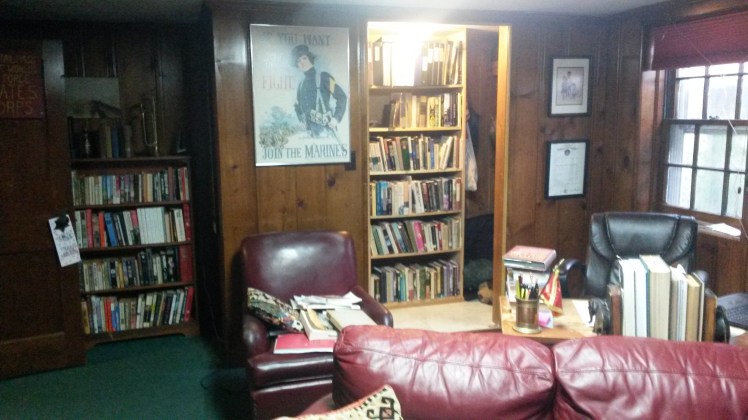
The picture above was taken today of the home office I’ve set up in the basement of my house since retiring. The picture shows fewer than half of the books in that room. There are also sizable numbers of books in the living room, bedrooms, basement hallway, and the room we refer to as “the book room.” I got the idea of calling it that from T.E. Lawrence, whose home “Clouds Hill” had a book room, a bunk room, a music room, and a bathroom. I did a rough count of the books in my house recently. By counting the books on a couple of shelves I worked out that one of my books on average occupied 1 inch of shelf space. I then took a tape measure around the house and measured the bookshelves. I came up with an estimate of 3600 books. This was a little disappointing, because I had come up with a similar estimate a few years ago! I have been buying books since then, disposing of only a few, and when I retired I took an estimated 500 books home from my office and a common room across the hall. Well, they were rough estimates. My books are organized by genre. I enjoy locating a book in my collection, or just browsing through them as a break from writing.
I agree with what Susan Sontag said of her book collection, which is that it is both personal history and also a reflection of social and intellectual history of ones times. I have a few books that were in my house when I was a kid. A couple were passed down from grandparents and my parents’ siblings. I have a copy of Rupert Brooke’s poems given to my grandmother. On the inside cover is written,”From Mother and Papa/To Fleeta Dec 25-1916.” We have a copy of Mary Poppins stories published in the 20’s that belonged to my mother’s brother. I have some of the first books I bought on my own as an adolescent. I bought the first volume of Bertrand Russell’s autobiography at Brentano’s in Greenwich Village on a trip to the city when I was about 15. Others are from my active duty days and grad school, my Joseph Conrad and E.M. Forster phases (never quite ended), Wittgenstein and postmodernism, and my growing professional library, maybe starting with The Washing of the Spears on the Zulu Wars by Donald Morris.
I think my favorite part of my book collection is the subset that made it into my sons’ rooms, chosen and appropriated by them. I had always hoped that my books might form a kind of family legacy. Not so much the books themselves, but the memory of them and of growing up in a house with books. The kindle and other electronic books have undeniable advantages, but I can’t imagine them lending themselves to a family home the way the old books do.
My work on Soldiers and Civilization involved a lot of books, some of which have made it into the “permanent collection.” In writing my next book, “How to Think Like an Officer,” I’ve been reading some new books, but also combing my collection for some of the books I first read years ago, since I am interested in how reading, maybe early reading in particular, forms the way we think, often in ways that are hidden from us. A book that fed my youthful interest in the military was Ernest Tucker’s The Story of Knights and Armor, a collection of illustrated historical vignettes from Roman through medieval times. The stories were simple but feeling, almost always with a young soldier who makes a rocky start but does well in the end through pluck and brains. (I knew that would be me!) Later reading and experience would give me a more complex picture of soldiers and armies (and of myself!) but the underlying idealism of those early stories I suspect never quite left me, sometimes for ill but mostly in a way for which I continue to be grateful.
 Soldiers and Civilization