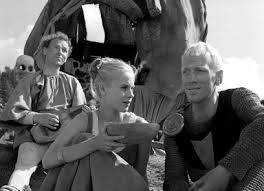
The Veteran

7th seal

I promised a post about what veterans can contribute to the larger culture. This is hardly a subject that I can exhaust in a short post, but I’ll put down a few thoughts and maybe continue later.  Veterans have often seen how good and how bad things can get. They’ve experienced the heights of service and comradeship, courage and loyalty.  As I’ve said in this blog before, I never felt the kinship of all people so keenly as I did when I was coming back from war, with the possible exception of the birth of my first son.  The veteran has also seen how fragile a thing are our lives and the collective lives of cultures and communities.  I saw Iraqi society collapse like a house of cards in 2003. In An Nasiriyah, the thugs and criminals came out of the woodwork with the breakdown of order.  US society is more stable than that of Iraq, but plenty of American cities and towns are not so far away from a similar state of nature.  This doesn’t make me an authoritarian, by the way, but a believer in social connectedness.  Iraqi society was held together by authority of a very direct, brutal kind, and when that went away it had no source of cohesion, in fact it had already been fragmented by fear.  This is something else the veteran often knows: what fear can do to people, how quickly it can remove the veneer of civilization. I worry sometimes that our society is too dependent on greed and narrow self-interest.  A strong dose of fear and want would have some of us preying on our neighbors without scruple.

Some of you may recognize that the picture above is from Ingmar Bergman’s The Seventh Seal.  The knight comes home burdened by sadness and guilt over his crusade. He finds that home is not a secure refuge but is on the point of collapse due to plague.  He’s used to fear, so he can keep his composure, and finally he saves the young couple in the picture and their child by distracting death at chess: something he can do because he’s a soldier who sees what’s coming, who has been trained to think as a tactician, and who values the love he sees holding the family together, giving them a better chance of survival, and maybe more right to survive, than the other travelers.

Next post: As long as I’m on rather gloomy movies, who’s seen, These Are the Damned?


Marshall: Conclusion

If Marshall’s private life prior to his days of greatness as the “organizer of victory” give us an idea of some of the influences that shaped his character, a consideration of his later years can make him human and sympathetic in surprising ways.  The man who claimed to have rid the Army of a lot of “arteriosclerosis” by purging the officer ranks of older men recognized as early as 1940 that old age might be creeping up on him.  Applying the same standard to himself as he did to subordinate officers, he tendered his resignation as Army Chief, suggesting that a younger man might be better for the job. This offer was rejected, but in 1951, after just under a year as Defense Secretary, and embarrassed by what he feared was a failing memory, he resigned from that post, ending a life of public service but for a brief return in 1953 to head the U.S. delegation to the coronation of the young Queen Elizabeth II.  Judging from the Pogue interviews conducted in 1956 and 57, his memory appears to have been quite good even a few years later, although like many older people it might have been better for recalling the remote past than for recent or daily events.

It must have been bitter for Marshall, who had honed his mind to operate at a high level, to see these powers slipping away, and then to have them severely impaired by a stroke, but he bore it bravely, even with the sense of humor he thought so vital to leadership and life. Another disappointment of his later years must have been the fact that this strong and wise man, almost fashioned to be a father, would have no children of his own.  Although Marshall inherited a family of two boys and a girl with his widowed second wife, these were Browns, not Marshalls.  The pictures of him uncharacteristically beaming with groups of children and the joyful recollections to Pogue of his own childhood suggest how much it might have meant to him to have been a father.

Marshall was mortal and fallible. Like the rest of us, he existed within the limitations of his times and his innate capabilities.  He was (to quote a phrase from Joseph Conrad’s Lord Jim) “one of us,” but he may have been, among American officers especially, the best of us.  He is a reminder that greatness may be within the grasp of many if not all.  In the search for whatever greatness may lie within, our mistakes and failures are as necessary as our triumphs and achievements. But most important is a constant striving, not to make an impression or merely to be heard, but to make a difference, to make the world a better, safer, more just home for humankind.

Next Post: Roman Warfighting


Humility and Getting it Right

To his biographer Forrest Pogue and others close to him, Marshall was noteworthy for his humility.  In a sense, his attitude towards himself and his own accomplishments can be our guide to approaching and understanding him.  When he became Army Chief of Staff in 1939, Marshall could look back on a career of nearly forty years during which he had trained himself and thousands of others to think about complex and time-sensitive military and broadly strategic questions.  He knew that these matters were too difficult and often too subject to chance and incalculable factors for him always to get it right or have the answer.  A careful planner by habit, he sometimes showed the impulses of a gambler.  His desire for an early landing in northwest Europe was eventually overruled. He likely had too much faith in the ability of airborne forces to operate independently.  His decision to limit the Army to 90 divisions was a near-run thing might have been, in the words of an official Army history, either “an uncommonly lucky gamble or a surprisingly accurate forecast.”

An important benefit of Marshall’s humility was that he seems never to have lost the habit of learning, even once he had reached an age and received a degree of adulation that would encourage in many people a sense of their own omniscience and infallibility.  Pogue records the openness and curiosity that the aged Marshall displayed.  Even during the interviews in the last years of his life, Marshall would ask Pogue about the precise meaning of a word. During a discussion of some changes that he had initiated as commander of the Infantry School at Fort Benning, Marshall had this to say-

“As I have said several times, this puts me in the embarrassing position of seeming to be the one who knew.  Well, as a matter of fact, throughout all of this, I’m largely recording my reactions to the experiences of the AEF and later training the army when I was with General Pershing, and my own experiences in those schools.”

Marshall saw himself not so much as a person of special abilities or even knowledge, but rather as the repository and conduit of much institutional knowledge.  If he had a special trait, it was perhaps his receptivity and retention of knowledge that was there for the taking.

Marshall’s modesty actually led to one of his most long-reaching decisions, which was to create the office of Chairman of the Joint Chiefs of Staff, and to recommend the very able Admiral Leahy for the post.  Marshall was sincerely uneasy that he might be having an undue or unchallenged influence on the president, since the arrangement before Leahy’s appointment led to Marshall having in effect “two votes” to Navy chief Admiral King’s single vote.

Another example of his humility and his very great desire to get it right was his willingness to modify his views on a subject, either in the light of new evidence or simply on reconsideration.  One very important change of mind he had as chief of staff concerned the question of aid to Britain.  At first intent on building up the small and weak American army in preparation for war, Marshall came to realize that there were moral and practical reasons for providing aid to Britain.  One decision that caused him much doubt was whether to “lend” some B-17s bombers to the RAF. The ostensible reason for this was to give the new American airplane some testing in battle, but Marshall worried that this was really a pretext to provide aid to Britain, and that the loan was not really motivated by any potential benefit to the development of an American weapon for use by American forces.  In the end he approved the transfer of the bombers, and he was relieved to later learn that the use of the B-17 by the British actually had resulted in some useful lessons learned for American aircraft designers and pilots. Another issue on which Marshall altered his views was the relief of MacArthur.   He hesitated to go along with President Truman and his other principle advisors, and he asked permission to review the file on MacArthur before reluctantly recommending MacArthur’s relief.

Next Post: Conclusion