On Writing How to Think Like an Officer, Part II
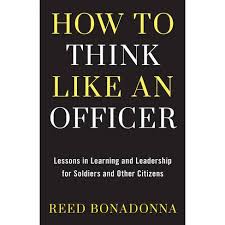
How To Think Like An Officer - By Reed Bonadonna (Hardcover) : Target

George C. Marshall

George Marshall was Army Chief of Staff in World War II, Secretary of State and Defense under Truman, and he remains the only American professional soldier to be awarded the Nobel Prize for Peace. I was introduced to the Marshall legacy as a plebe at Virginia Military Institute, our common alma mater, and he’s been my personal hero ever since. In the writing of How to Think Like an Officer, Marshall was my gold standard for officer thought for his combination of integrity, sheer professional competence, and broad humanity. I mention Marshall often in the book, and at times I felt that I could feel him watching me from the framed portrait that hangs on the wall opposite the desk where I write. Not least among Marshall’s achievements was that he inspired the writing of the original, 1950 edition of The Armed Forces Officer.

The Armed Forces Officer

I was issued a copy of the Defense Department publication The Armed Forces Officer at the Marine Corps Basic School as a second lieutenant. We were never assigned to read or to discuss the book that I can recall, but I exceeded my instructions, read it and fell in love with it. The Armed Forces Officer is highly literate, personal, and allusive, in contrast to the abstract and frankly unlettered tone of many other works on leadership. The idea of writing a guide for officers originated with The Armed Forces Officer, and much of the spirit of the The Armed Forces Officer also enters into How to Think Like an Officer

On the Psychology of Military Incompetence

At the other end of the spectrum from Marshall and The Armed Forces Officer, On the Psychology of Military Incompetence by Norman Dixon inspired me to think about the pitfalls to military officer thought, about why we hadn’t learned to do things better. Dixon advances the fairly simple thesis that much military incompetence can be traced to a prevailing authoritarianism in military culture. Others have written on the subject in a more nuanced way, but Dixon gets credit to being first, or at least staking out the field, and for writing what is still, over forty years later, a very interesting book.  I came to believe that the limited diversity of the largely male-Caucasian officer ranks can be another impediment to clear thought, as can the complex relationship of military service and masculinity. The nature of armed conflict can also offer obstacles to thought.  Officers must think under very stressful conditions, and they may take refuge from the chaos of the battlefield in overworked formulas and unimaginative solutions.  Military service can also take a mental toll, bringing exhaustion, isolation, and various forms of psychological trauma. These factors make the care and development of the mind a high priority.      

Moral Prudence

One way out of incompetence was suggested to me by a lecture at the Stockdale Center of the U.S. Naval Academy by Gregory Reichberg. Reichberg drew my attention to a little- known section of Thomas Aquinas’s Summa Theologica in which Aquinas argues that military command is not a matter of mere fortitude, nor of art, but that it is an act of moral prudence, a trait involving both intellect and character. Moral prudence enables the officer to go beyond the pursuit of military victory or narrow national interest to encompass a greater good. This struck me as a powerful tool through which to view and guide the thinking of officers. I wound up meeting with Dr. Reichberg and later writing a review for his book, Thomas Aquinas on War and Peace. I later wrote a couple of articles on military command as moral prudence, and in revised form these formed an important part of the chapter on the intellectual virtues in How to Think Like an Officer.

Soldiers and Civilization

A late entry into my inspiration line-up was my previous book, Soldiers and Civilization: How the Profession of Arms Thought and Fought the Modern World into Existence. In that work, I traced the historical and literary origins of the military profession in order to make the argument that (to quote from the book) “The soldier has played a vital, inescapable, and neglected role in the formation of human civilization.” Having made this argument, How to Think Like an Officer in effect became a book about how the officer might continually learn and grow to fulfill the expansive role I had claimed for her. Much of the research I had done for Soldiers and Civilization was helpful, although far from sufficient, in the writing of How to Think Like an Officer.  The latest book required other forms of learning. Soldiers and Civilization had organized itself in chronological order, starting in classical time and slogging   into our own century. No such ready-made organization was on hand for How to Think Like and Officer. I wrestled with the organization, juxtaposing pages and chapters until the pieces seemed to fit.    

Next: “Something Urgent”

On Writing “How to Think Like an Officer”

Hello! This post constitutes a return to this blog after a long absence. If not exactly a triumphant return, I hope it will be enjoyed by at least a few readers. I plan for two more posts on my new book, How to Think Like an Officer, and then more to come on other subjects.

My latest book, How to Think Like an Officer: Lessons in Learning and Leadership for Soldiers and Other Citizens, was published by Stackpole Books in September, 2020.  This was my third book, if you count a doctoral dissertation that was eventually published in book form. I continue to write, and another book may be on the way. Meanwhile, like an anxious parent, I’m trying to gauge the reception and influence of a book the publisher described as “genre-bending.” Of course, the book was more than a marker in my literary career. It is the culmination, thus far, of military service that covered three decades. It was a kind of capstone exercise, although maybe the beginning of something as much as an end, as capstones generally are.

I served in the Marine Corps for close to thirty years combining active duty and reserve service, as an infantry officer and field historian, with deployments to Lebanon and Iraq. In Iraq, on the day the task force I was assigned to entered Nasiriya, a lieutenant, upset at the casualties (many, we later realized, from friendly fire) and what seemed the general muddle, asked me why, “after 225 years” we hadn’t learned to do thing better.  My latest book draws on my service the questions it raised about how to do things better. Along the way were a few moments and connections that were especially important, moments when I was inspired and encouraged to write a book.

Writing a book is always a matter of sitting down in front of a keyboard (every day, preferably) and pounding at the keys. Along with the persistence, or “perspiration,” inspiration is important too.  Writing a book is a search for sources of inspiration, for a flow of ideas that can be sustained over months or years of writing and finally across hundreds of pages, each one carefully reworked as the main object is enlarged and refined. To give an idea of how this works, or at least as it worked in my case, I will briefly discuss some major sources of inspiration for How to Think Like an Officer in rough chronological order.

Teaching and Getting Started

Two episodes in my second career as educator provided impetus. As a distance education adjunct with the Marine Corps Command and Staff College, I would sometimes rather grandiloquently say I wanted the course to be an inquiry into the nature of military professionalism. At one point, in reply to some remark of mine, a student said, “What you really mean is that the military profession is a branch of the humanities.” This was a “a-ha” moment, opening up for the importance of such neglected areas as language, creativity, and self-knowledge to military professionalism. Later, during my years at Kings Point, the U.S. Merchant Marine Academy, I would sometimes tell the midshipman, “I’ve got (x) months/years to get you thinking like an officer.” (In addition to becoming licensed officers in the merchant marine, all midshipmen who are U.S. citizens were required to accept a reserve commission in some component, unless, as about 25% chose to do, they enter active duty after graduation.) Needless to say, some midshipmen wanted to know what I meant by that, sir? I also encountered Academy colleagues (some of them officers) who I thought needed to think more like officers.

In my years teaching for the Command and Staff College and Kings Point, an idea of what constituted officer thought was gradually coming to me. I wanted my students and colleagues to be able to think like organizers and tacticians, but I was also formulating a broader view of officership, of officers as more than mere “managers of violence,” as sometimes resembling scientists, sometimes artists, sometimes dreamers and visionaries, but other influences had to make themselves felt to help me complete the picture.

To be continued…


George C. Marshall on Donald Trump

I wrote this piece during the 2016 Presidential campaign. It never went anywhere, but as I’ve been reading Daniel Kurtz-Phelan’s excellent The China Mission: George C. Marshall’s Unfinished War, 1945-1947, and watching the news of DT’s clownish efforts at diplomacy, I’ve been inspired to put it on my blog.

George C. Marshall and Donald Trump

            When I was a cadet at the Virginia Military Institute, the image and memory of George C. Marshall, VMI Class of 1901 was hard to avoid.  Physical reminders included the Marshall Library on campus and Marshall Arch, the main entrance to what is still called “New Barracks” (although it is now over sixty years old).  More than this, Marshall was recognized as our most distinguished graduate.  His unmatched record of service as Army Chief of Staff in World War II, as Secretary of State and Defense after the war, and his status as the only professional soldier ever to win the Nobel Prize for Peace, were seen as a precious gift of the Institute to the nation and to the world.  I caught the reverence for Marshall as a plebe, and it has grown with me over the years.  Marshall can be such a towering figure that he may seem remote or impossible to emulate, but I’ve learned that he was very human. He was often dissatisfied with himself, and he had to work to control his temper.  Sometimes seen as chilly and aloof, he could be funny and affectionate, expressing his concern for others in quiet, even anonymous ways. 

            As a cadet, Marine Corps officer, even as a parent or employee, I would sometimes ask myself, “What would Marshall do in this situation?”  This may strike some people as naïve.  I can only say that a conversation, even an imagined conversation, with a great person can be good for you.   A question that popped into my mind recently is “What would Marshall make of Donald Trump?”  To do this right, one would have to make allowance for differences of time and circumstance.  Marshall never ran for public office, so the somewhat undignified antics of political candidates on campaign was something outside the range of his own behavior.  He knew the political system, however, and he understood its demands and separate culture. Marshall had also rubbed elbows with the very rich of his day, and he was acquainted with the effect of great wealth on a person’s personality and development.  So real estate tycoon-turned politician Donald Trump might have come in for the humorous tolerance that Marshall displayed for the sometimes outlandish figures of the political and financial landscape.  Even so, and even allowing for the differences between mid-twentieth century America and the nation as it is today, I think Marshall would be appalled at the spectacle that is Donald Trump.  Marshall the logical, deliberate, and humane planner would have found Trump’s emotionalism and his sweeping, untaught pronouncements on strategy to be unseemly and dangerous.  Trump’s appeals to fearful xenophobia would likely have struck the author of the design for European recovery that has gone down in history as the Marshall Plan in the same way.  Trump’s blowsy posturing and grimacing behind the podium might have reminded Marshall of the rhetorical styles of some of the despised dictators of his own day, perhaps of Mussolini especially.   Marshall was known and revered above all for his integrity, and Trump’s lies and misrepresentations (about his own business success, for example) go far beyond what Marshall had come to expect and even accept among some politicians. 

            A strong indication of how Marshall would have responded to Trump is Marshall’s reaction to another bully and demagogue, Joseph McCarthy.  McCarthy attacked Marshall in Congress, blaming him, in rhetoric eerily similar to that of Donald Trump, of responsibility for America’s “retreat from Communism” in China and Korea.  McCarthy’s claims amounted to a charge of treason. His disdain for the facts and his abusive language appalled even the members of his own party, but he persisted in the manner of people whose egomania has canceled out sense.  Marshall’s response to these attacks was cool.  He never replied to them in public, and when a reporter offered to provide material for a rebuttal to McCarthy’s scurrilous charges, Marshal replied, “I appreciate that, but if I have to explain at this point that I am not a traitor to the United States, I hardly thinks it’s worth it.”         

Of all of Trump’s shortcomings, his treatment of women might have aroused in the gentlemanly Marshall the greatest contempt.  Marshall cared for an invalid wife for the over twenty years of his first marriage, never breathing a word of the toll this might have taken on him. Second perhaps only to the relief of MacArthur on Marshall’s watch as Defense Secretary, the decision which may have attracted the most criticism from McCarthy and the rest of the far right was his appointment of Anna Rosenberg, a Jewish woman, as Assistant Secretary of Defense for Manpower.  Marshall came to her defense when the appointment was challenged in Congress. Later, she helped to convince Marshall to begin the racial desegregation of the armed forces.  A man of his times, with the strengths of those times, Marshall had the ability to see beyond the limitations of his upbringing and early years.    

Marshall the selfless public servant I believe would have seen through Trump’s pretensions. He would have observed Trump’s contempt for law, his incitements to violence and divisiveness, his ignorance and mendacity, and Marshall’s steely, blue-eyed gaze would have dismissed him as the mountebank that he is.