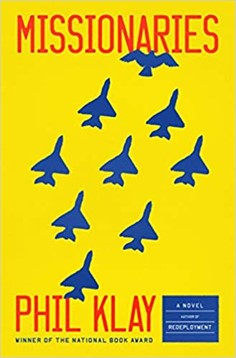
Missionaries, Part II

            Missionaries explores several themes of armed conflict in the modern world. One of the things we learn in Missionaries is how the killing takes place. In Missionaries, killing takes many forms, although the ends are the same: a violated and lifeless body. One man is cut in half with a chain saw. A woman is ordered to step in front of a speeding truck or see her children killed in front of her. Another is hacked with axes, although she survives what was intended to be a lethal attack. Klay does not omit the gory details of these killings and intended killings from his narrative. A character in the story notes that her editor’s refusal to publish the details of some deaths she has seen is a sign of cowardice. The bloody facts are an important part of the story. We dare not turn away.

            But for many of those who do the killing in the modern world, the killing is remote, done by machines or by others whom those giving the orders neither see nor know. Killing is covered over with layers of bureaucracy and Orwellian language. We learn that a change in a criminal or terrorist organization’s categorization can result in an instant and decisive change in the weapons  used to combat the organization. Suddenly aviation, surveillance, and fire support resources become available. Greater risk of “collateral damage” may be countenanced, adding up to more dead bodies, although perhaps (it’s rarely certain) to a more stable security situation and greater safety for the residents of a region.

            Another theme pursued in the book concerns the deals and compromises made in the pursuit of long-term goals. This is most represented by Luisa, a character whose father was the victim of a chain-saw execution, but who is now willing to negotiate even with the men who killed her father in an effort to tame the bandits and reduce the level of violence. Her view of these arrangements seems clear-eyed and logical, but we are still left with doubts about the effects of the trauma she has suffered, and concerning her ability to manage as she claims the often unstable men of violence.

            Missionaries begins with the shocking and sudden destruction of a main character’s Colombian home village, and it ends with more scenes of estrangement and absence from home. Throughout the novel, the subject of home and exile is presented, in one of the elements linking Klay’s writing to that of Joseph Conrad. The character Abel whose village is destroyed is constantly trying to recreate a place he can call home, and then usually seeing his shaky domesticity ruined by forces beyond his control, if out of his own past. The American journalist Lisette revisits her home in Pennsylvania from an assignment in Afghanistan, but she quickly departs for Columbia, where she seems to renew a relationship with a former American soldier turned mercenary that, however, does not prosper. For the American special forces soldier Mason, being in the army now means that he must leave and lose touch with the family he loves. He’s warned by another character against looking at pictures of his wife and child while on deployment. The roles of husband/father and warrior appear in his case incompatible. The Colombian officer Juan Pablo tries to keep his daughter within his influence, but her university education and associations are drawing her away, and he is later forced to accept employment far from home when his military career founders.

        All of these people, the Americans perhaps especially, are not only missionaries but nomads, in the sense given the word by critics Deleuze and Guattari in their work Nomadology: The War Machine.  Perpetrators of war and those caught up in war are nomads who inhabit unstable lands not of their own origin, displaced by war and acting in a way to displace others.  

            Juan Pablo has some of the last words in the novel, and his confident assertion that by killing the barbaric bad men and terrorists he is advancing the cause of civilization may be one of the things that stays with us at the end, but some disquiet is likely to remain. Klay has presented a complex picture of the war machine, which belongs to no one, but always lies in the violent space between nations and individuals where conflict takes place. No one can control it, because it is always reciprocal, self-destructive as much as other-destructive, a tool of ill omen, even when there is no other.    

            I was left at the end of Missionaries with a sense similar to how I felt after watching No Country for Old Men with my then 15-year old son at his birthday request. There was a debate in the movie about how much of this was new. Did the arch-villain represent a new form of evil, or was he simply a manifestation of a millennia-old malignancy tricked out with new new/old skills and weapons?  If Missionaries shows us the conflict of our time, is it different but for details?  The technology has changed, and with it the level of connectedness among scenes of conflict. The essentials of death and dislocation remain, but the changes may indeed be adding up to something fundamentally new, something we had better try to understand, before it eats us alive.     

Phil Klay’s Missionaries

About a year ago, I was invited to moderate a book club for veterans conducted by the  Intrepid Sea, Air and Space Museum. The first meeting was conducted on board the vessel, now moored permanently on the west side of Manhattan. Since then, meetings have been held on Zoom. The meetings have attracted a diverse mix of veterans and also military family members.  So far, we’ve read A Woman of No Importance, The Yellow Birds, and Bloods. Our next selection, which we’ll discuss on Zoom on 15 December, is Phil Klay’s Missionaries. At this meeting we will be honored by the presence of the author.

I thought Klay’s short story collection, Redeployment, probably the best book to come out of the American Mideast wars that I’d read, so I looked forward to Missionaries. I can’t say I was disappointed. Klay’s writing has if anything gotten better. One of the strengths of Redeployment was Klay’s ability to speaking in different voices. As a Marine, I took to Redeployment partly because most of the stories depicted a Marine Corps that was familiar to me, while the book also made me see things about my service that I hadn’t previously. Most books to come out of our recent conflicts have been in the form of memoirs or fiction that sailed quite close to the writer’s experience. Redeployment in a sense illustrates the strengths of fiction by taking us into the lives of a diverse group of individuals, to include a chaplain, a lance corporal in an artillery battery, and (in the title story) a married infantry sergeant returning home.  The author in effect sets an example of empathy and imagination because he’s writing outside his own perspective.       

But still, in Redeployment, Klay was mostly writing about Marines in settings that were personally familiar to him. In Missionaries, the four main characters are a Colombian peasant turned paramilitary, a Colombian special forces officer, an American journalist, and an American special forces NCO. The novel is set mostly in Afghanistan and Colombia. Klay writes with authority on his settings and characters, an authority apparently based on years of research, much of it done in the field. Missionaries tells a complex, far-ranging, compelling, and page-turning narrative. In addition to this, Klay has avowedly set himself the ambitious task of educating people on the nature of modern armed conflict, with particular attention paid to the sometimes hidden cost and consequences of U.S. global armed intervention.  

In the posts that follow, I will be discussing Klay’s accomplishment. Readers expecting a ringing condemnation of U.S. military operations will be disappointed. Klay’s depiction is more nuanced than that, and he does not so much make judgments as challenge us to make them, as we shall see. I’ll conclude my discussion of Missionaries with a report on the book club.  

Next: Different voices             

Reveille

I know that I said I would post next about Phil Klay’s new book Missionaries, but for a variety of reasons to do with timing and urgency, I’m going to post instead an op ed piece I recently wrote for Veteran’s For American Ideals (VFAI). The piece might get picked up in some news media, but meanwhile the readers of this blog will be able to read an advance copy. Post on Klay is coming!

Reveille           

For years, I misunderstood the Constitutional Oath which I regularly retook as a U. S. Marine. In fact, for a long time, I missed the point entirely. What did pretty words about freedom and democracy have to do with me? I was a member of a highly disciplined organization that frankly dealt in violence. It took deployments to Lebanon and Iraq to shake me from these complacent, mistaken beliefs. I eventually came to realize that it was precisely because military organizations had the power to oppress and do harm that members of the armed forces had a particular obligation to keep faith with the ideals that inhere in the Constitution.

My experiences in Lebanon and Iraq opened my eyes to the extreme fragility of the democratic institutions and attitudes that permit citizens of a country to live and to flourish in freedom.  Lebanon and Iraq were countries that had given way to tyranny, divisiveness and disorder. I remember looking down a street in a once-beautiful, downtown district in Beirut, where buildings were so pockmarked with bullet holes it resembled natural erosion. But, this was no natural process, nor was it the work of an external invader. It was the people of Beirut themselves who had largely destroyed their own city during a brutal civil war. In Iraq, a shaky constitutional republic had been allowed to yield to one-man rule, leading to a predilection for aggressive war and oppression. I remember the tumultuous welcome we received from the people of Iraq who saw us as a means to restore their freedom, but efforts to restore democracy in Iraq illustrate how difficult it is once democratic institutions are lost, and that military force alone is not the right tool.

Like many of my fellow veterans, I came back from my combat deployments saddened, and even chastened, but with my faith in America reasonably intact. I now knew well that democracy was a fragile thing. But it never occurred to me, until recently, that this fragility might apply to my own country as well. After all, we purported to export freedom and democracy, so secure in our own institutions of liberty that we would spend American lives and resources to establish them abroad.   

The last few years have been quite an awakening. Although America is not yet quite on the verge of resembling Iraq or Lebanon, I see signs of the decline in democracy that has led to conflict and oppression elsewhere, and that we have seen before in our own history. Efforts to suppress voting have grown from the manipulative to the blatant. A sitting president encouraged his followers to keep their fellow citizens from polls and to discount their votes when cast. All this has been the culmination of an administration repeatedly undermining democratic institutions, including efforts to politicize and otherwise weaken the constitutional foundation of the armed forces.

These developments should ring an alarm, loud as the sounding horns used by Marines to warn of an enemy attack – or perhaps like the notes of Reveille, waking us from complacency. Like many veterans, I have abandoned the apolitical position that I maintained for years in the mistaken belief that, as a military professional, even in retirement, I was aloof from political matters. We have realized that the republic we swore an oath to defend is now threatened as surely as from any external threat. If we don’t wake up, the beautiful America of our dreams, the reality and the aspiration, this shining city, may begin to disappear like the last poignant notes of a bugle, blowing not Reveille, but taps.

But this is a time for hope, not for despair. A generation of politicized veterans is joining a movement of citizens in an exercise in participatory democracy that the country has perhaps not seen since its origins. The electorate recently voted to unseat an anti-democratic demagogue. The challenges are great, but the opportunity is even greater. In the months and years to come, we will strengthen social bonds weakened by years of divisions and a pandemic and achieve a promise that has never quite been fulfilled. We must all work, each citizen in their own way, but all in some way, to strengthen and renew the American dream of democracy – not an America great again, but an America great anew, with a Constitution that applies to all, and that we can all believe in. 

On Writing How to Think Like an Officer, Conclusion

“Something Urgent”

The physician, poet, fiction and essay writer William Carlos Williams wrote of “something urgent I have to tell to you.” The “something urgent” that someone tries to relate in a book may grow gradually, over the course of years and even a lifetime. The search for inspiration, for urgency, requires openness and curiosity. Of course, it took more than persistence, curiosity and inspiration to write the book. There were of course other influences than those I have listed. All books are perhaps acts of presumption, although mine may have been more a matter of effrontery than most, since I was telling people how to think (although, in my own defense, generally not what to think!)    

The high concept of military officership and professionalism explored and expressed in my last two books is made urgent, I believe, by several factors. Armed forces are being called on to prepare for and to conduct a wide and changing spectrum of operations. This is taking place in a complex, divisive domestic political context and an unsettled global situation that the current pandemic has both highlighted and exacerbated. The moral and personal challenges to the profession of arms have perhaps never been greater. Officers are going to be required to learn more quickly, to think more deeply, and to move out more smartly than perhaps the soldiers of any other era. Very recent and current events in the United States seem to be writing a new page in this history of civil-military relations, potentially placing a strain on the American officer’s Constitutional oath without precedent for over a century and half. We hope that this feverish period will pass quickly, but some of the questions of duty and obedience will remain even when the crisis is passed.

One way to meet these present and future challenges is to practice our cognitive and communication skills by reading widely and trying to write every day, even when we’re tired and frankly fed up. I hope that what I have written in this short essay might encourage some readers to write their own books. Most people likely have a book in them somewhere, and that might be especially true of military veterans, our minds full of stories and unprocessed impressions crying out for development and articulation. Keep it up: keep hitting the keys, and keep your eyes and ears open for inspiration. One day maybe you’ll wake up find you’ve written a book, as I did, and that it was worth the effort, a belief in which I persist while the jury may still be out on How to Think Like an Officer!        

Coming up: The Intrepid and Phil Klay’s Missionaries